

Murals are living works of art. They become an integral visual part of a neighborhood—they reflect the passing of time, mark communal celebration, and bear witness to resilience. A mural represents an ongoing conversation between art and community, and sometimes the original work needs as much care as the people who pass it on the street or see it from their windows.
In partnership with vitaminwater, Neighborhue returns for a second season, expanding from the Latine neighborhoods of Brooklyn to Orlando. While the first installment focused on revisiting iconic NY murals to brighten their original vibrant colors—a quality shared with vitaminwater—season 2 builds on that vision. This time, the artists are working with what is already there to push their work further, adding refreshing new layers shaped by where their communities are and where they are headed next, working under the hot sun as the days go by, hydrating with a fresh bottle of vitaminwater to make the hours go by faster. The results show how art can evolve, offering new perspectives while staying rooted in its neighborhood.
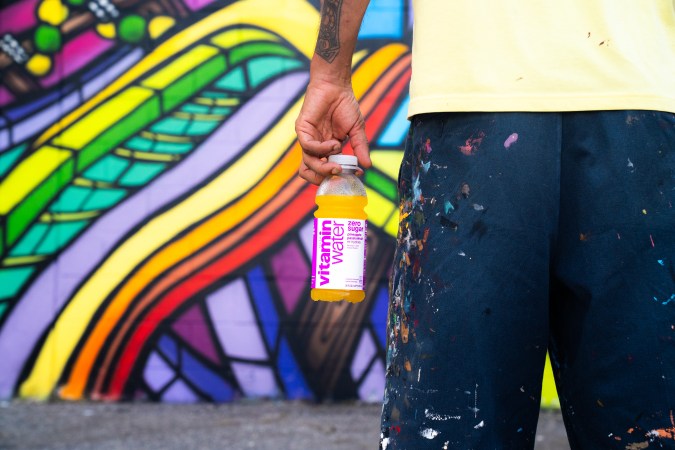
This episode focuses on Don RIMX and his mural, “El Chamán.” Born Edwin Sepúlveda in San Juan’s Nemesio R. Canales housing complex, he painted his first pieces there and has since developed a personal style that explores the connection between people and their environments. His compositions are characterized by brick and wood textures meeting vibrant geometric patterns. Since relocating to Florida in 2014, he has carried that approach across walls in Sierra Leone, Quito, and beyond, always tying the work back to the people and places it is made for. Now, returning to one of his own murals in Orlando, Don RIMX talks about what it means to revisit a piece years later—and what he is adding to it now.
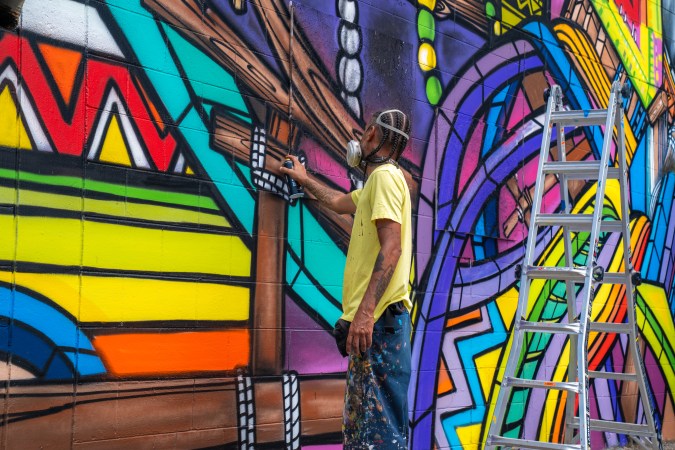
Tell us about the first piece you ever painted.
One of my friends was a producer, so we were learning about hip-hop and stuff like that. He was [an] inspirational figure, and he introduced me to graffiti. In my neighborhood, there was a concrete fence all around the caserío [housing project]. One day, we bought a couple of cans; my friend bought them for me. So we went out for the first time, and I created my first piece. It was graffiti, but I didn’t write my name. I wrote, “I AM.” That was my first piece. After that, I picked my name.
You’ve traveled all across Latin America. How have you fused that culture into your work, and why does it matter so much to you?
When I started making art, I never imagined it. Where I grew up, opportunities were something you had to earn, and the idea of traveling felt really far away. I started traveling really late in life, when I was in college. Every trip made me humble. Also, they have all been lessons. It was like, “We’re going over there; we’re going with a purpose and absorb whatever is there. We’re going to come back, think about it, and reflect.” For me, it was a way to build a cultural bridge between Puerto Rico and the whole world.
You make your art in places where there was no art at all, and nobody was taking care of it. Why is it important to make your work something that belongs in those places?
For me, every time I go to a place, I think, I’m going to make this little piece of change and take care of it as if it were my own neighborhood or my own house. You want it to be nice [and] you want to [feel] comfortable, like somebody cares about the place. And I think the neighbors are like, “Yo! Thank you for coming over here and adding to the love we have for this space.” And I feel great about being part of the energy and love of these communities. For me, that energy is contagious. It’s like, “Hey, if they’re doing it, then I’m going to contribute my little bit.” A project like this is like, “Yo! We did this together.” Conversations happen between people who would never have gotten together. I feel grateful for that. I work really hard to keep crushing the walls between us and bringing people together.
You painted El Chamán in 2017. What’s the story?
Every time you move to a different city, you have to try to blend in with the people, like when I moved from Puerto Rico to New York, from New York to Miami, and from Miami to here. I had just come back from Latin America, where I had been absorbing the culture, and when I came back, I was like, “Yo, I want to make a reflection about that.” So, I decided to make an image of somebody who cares about the community and also reflects our ancestors. Then it was about figuring out how to make the image fit perfectly in that space, because the wall isn’t flat — there are windows and all kinds of different stuff.
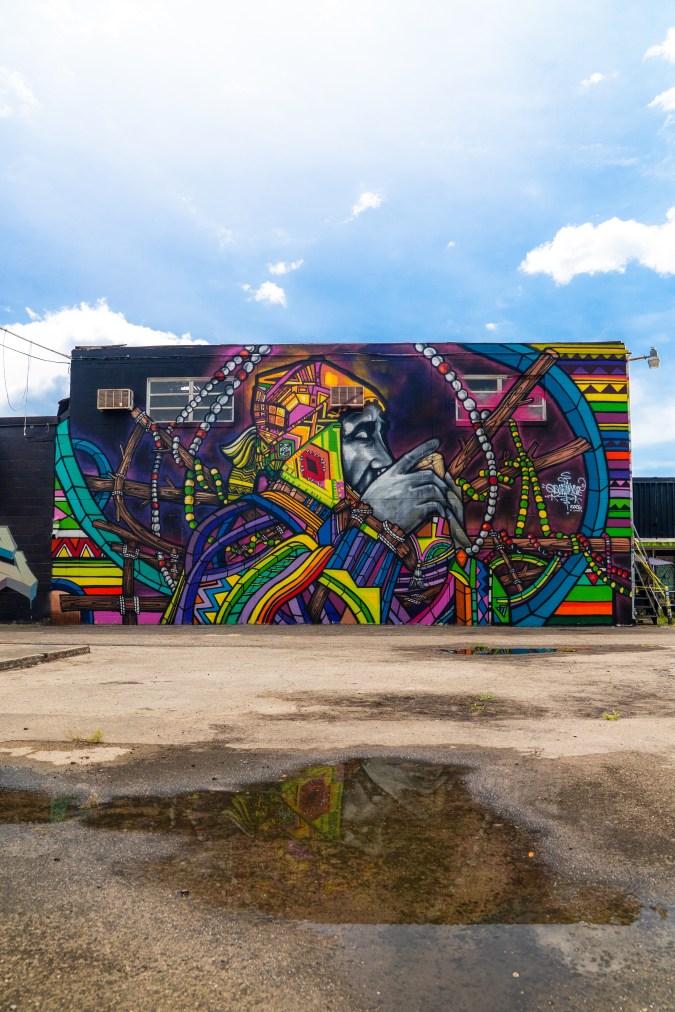
While working on El Chamán, you received some help from the surrounding community. What was that experience like?
It started one night; people were gathering, having fun, watching the process, and sharing techniques. That’s the part: sharing knowledge. In the underground, that’s the way we share. You show respect, introduce yourself, and learn and be part of the process. Honestly, that’s a good way to introduce somebody to the game. And the people who experienced that moment, who had that experience, they’re going to remember it and keep it for years. As for me, I grew up thinking that what you paint today could be erased tomorrow. That’s how graffiti was back then; it was totally ephemeral. If a piece lasts you more than a year, it’s a miracle. More than two years? That’s something else entirely. And nine years; that’s extraordinary.
Overall, how do you feel about this expansion process right now?
I feel honored because it gives the piece more life. If you do things with your heart, the energy is going to be something [special]. Imagine your energy in a piece over all these years.