

When Vidal Mendez arrived at college, he did what many first-year students are told to do: join clubs.
He tried. The engineering organizations felt “very transactional.” The networking events felt performative. “If I don’t feel connected with people once I’m in the room,” he said, “I just won’t entertain it.” As a queer Mexican student trying to find his footing, he kept walking into rooms that didn’t quite feel built for him.
So he built one himself.
As a freshman at Kennesaw State University, Mendez founded ALPFA—the Association of Latino Professionals for America—rooted in a simple belief he repeats like a mantra: “There’s always room for people to sit and eat at the table.” But Mendez’s story isn’t really about starting a club. It’s about what happens when you stop waiting for permission to belong and choose to be your full self in every room.

Today, Mendez is an industrial engineering student at Georgia Tech, spending the summer in Orlando and balancing a full course load with a technical operations internship at BNY. “I’m doing everything,” he laughed. “Quite literally. Everything.”
The schedule is intense by design. After two years of trial and error, he learned that a heavy STEM semester can be draining, so he strategically takes engineering classes in the summer to lighten his fall course load and protect both his workload and his energy.
Growing up as the youngest of seven siblings, Mendez was raised in a loud, loving Mexican household where there was rarely a shortage of opinions, personalities, or expectations. One of the people who shaped him most was his eldest sister, who stepped into a role somewhere between sibling and parent.
There’s a 15-year age gap between them, which meant he didn’t exactly grow up alongside her—he was, in many ways, raised by her. “She was like a mom to me,” he said.
For much of his life, Mendez measured himself by achievement: good grades, leadership positions, and quantifiable accomplishments. Looking back, he recognizes much of that drive as a desire for acceptance.
Then came a diagnosis that helped him understand himself differently.
Learning he had ADHD gave him language for experiences he’d spent years trying to explain. He began to learn how his brain actually worked, and how to work with it rather than against it.
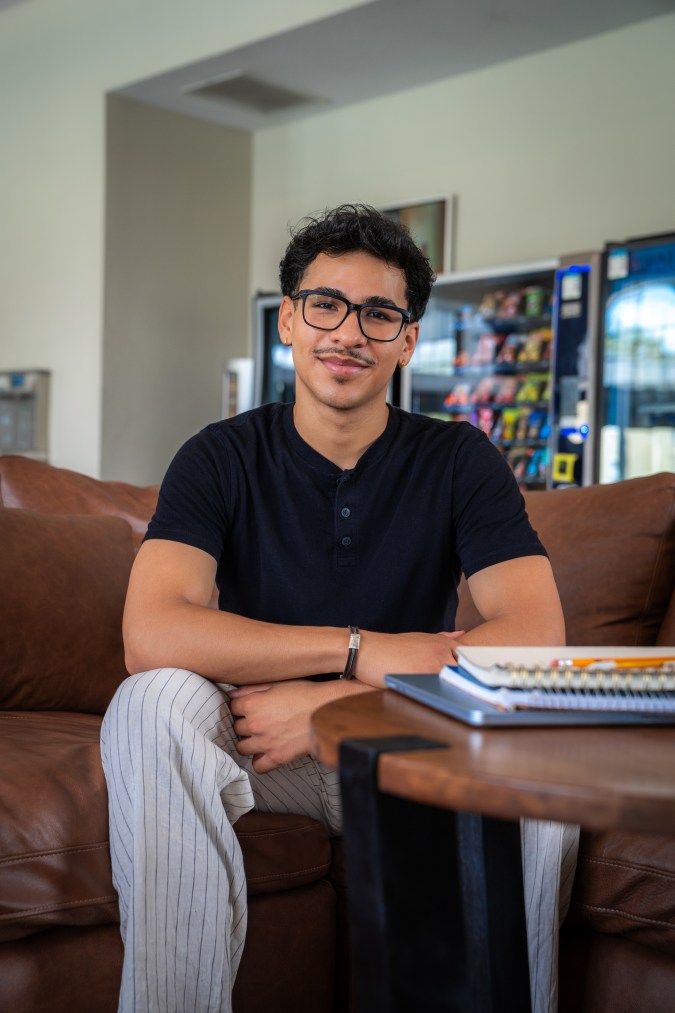
He admitted he was “just seeking acceptance.” He was seeking approval from family, chasing straight A’s, and looking for “some sort of reassurance.”
As he got older, that need began to loosen its grip. The version of success he was chasing started to change—less about proving himself, more about understanding himself.
Over time, that internal script shifted. He told himself—and now others—”You shouldn’t have to seek acceptance,” he said. “Take me as I am or don’t.”
For Mendez, the shift wasn’t only emotional; it was practical. Getting diagnosed meant he could stop trying to “figure out what’s wrong” in the abstract and start building real strategies—therapy, workshops, and systems that match how he operates. “ADHD for me is fight or flight,” he said. “So I’ve learned how to get ahead of it.” He either knocks an assignment out the day it’s given or does it right before it’s due, with almost no in-between.
In his first year of college, he expected clubs and organizations to be places where friendships formed naturally. Instead, many of the spaces he encountered felt centered on résumés and what people could offer one another professionally. He found himself looking for something harder to define: a place where people could show up as themselves.

ALPHA was his answer. He initially intended it to be a space built for connection instead of credentials. It brought people together beyond majors, résumés, or career goals—the kind of community he’d been looking for from the start.
“When you lead as someone different, it’s easier for other people to fit in,” he said. To make it feel welcoming, he’d loosen the room up—crack a joke, get a little “ratchet,” permit people to be themselves.

For Mendez, that’s what leadership is: making room. And community, too—not just shared interests, but a place where people can show up fully. “Community is a place where you can be unapologetically yourself,” he said. “It’s a place that wants you to grow.”
That mattered to him because he knew what it felt like to leave one behind. College was his first real chance to meet himself outside the roles he’d always occupied at home. The distance brought independence, but it also brought something less obvious: boundaries.
As he put it, in many Latino households, “boundaries” often translate to distance. “The only way Latino households are going to understand that is when you put space…distance.”
The experience also shaped the way Mendez thinks about engineering. He didn’t choose it because he loved equations. He chose it because he watched two older brothers build stable careers through civil engineering—and because he wanted to prove to himself that he could do the same.

But when he moved from civil to industrial engineering, it clicked. He discovered its real center of gravity: systems, psychology, and the way humans move through structures that were never designed with everyone in mind.
Today, he sees possibilities where he once saw a narrow definition of success.
He keeps returning to a forward-looking mindset: “It’s not about what you haven’t done. It’s about what you could do and what you will do.”
When asked what advice he’d give his younger self, Mendez didn’t talk about engineering. He talked about permission—permission to take up space, trusting that there was room for him exactly as he is, and knowing that if there wasn’t, he could create it.
“I like to be loud. I like to challenge the stereotypical norm of other people.”

But that confidence, he said, works best when it’s paired with awareness. He’s learned to listen first—observe, read the room, understand the system he’s walking into—then decide how to move through it with intention.

For Vidal, what matters is being fully himself on purpose—and making it easier for other people to do the same.
Target presents our latest installment of Remezcla Meets. Design your dorm, your way at Target.