
By sunset, Día de los Deftones looked like a mural come to life. City lights flickered behind papel picado, lowriders gleamed beside cempasúchil booths, and the band’s Mexican lager scented the air. Crowds spilled into Petco Park on Nov. 2 as corridos met distortion and rap crashed into reverb. For one night, San Diego, CA, felt like the capital of heavy music built by and for the culture that raised it. And as we close a year filled with political contention affecting our communities, the festival revealed something bigger: how cultural celebration can’t sit apart from escalating pressures facing the people it honors.
It’s hard to overstate what Deftones mean in Southern California. In the ’90s, when alternative and metal were overwhelmingly white, their breakthrough as a California-born multicultural band blending metal and melancholy into something transcendent felt revolutionary. Their existence expanded the Latine imaginary of where we could belong: in the pit, behind the mic, the center of eclectic noise. Back then, representation felt like resistance. Three decades later, it marks the start of a more complicated conversation about what we do with it when celebration meets a world on fire.
Formed in Sacramento in 1988, Deftones mirrored California’s patchwork. Founded by Camillo “Chino” (a nickname carried from home to stage) Wong Moreno, Stephen Carpenter, Abe Cunningham, and the late Chi Cheng, later joined by Frank Delgado, their bond came from skateboards, mixtapes, and misfit tastes. That collision shaped their experimental and evocative sound. In 1997, Moreno said, “We’re two Mexicans, a Chinese, and a white boy. Metal and punk don’t have to be white.” That truth shaped generations of outsiders and deepens what this music festival means now.
In its sixth year, the festival feels like a ritual. Part concert, part cultural offering. Each edition expands its language: cross-genre lineups, Spanish-language merch, community altars, calavera face painting. For most attendees—largely Latine—it’s where identity meets sound and belonging takes on gravity. But when culture becomes the architecture of space, it also becomes a mirror.

This year, that reflection felt complicated. Since its inception, the festival has taken place in the borderland hotbed defined by border politics, immigration raids, and anti-Latine hostility, yet the current climate makes those dynamics feel especially hard to ignore. From the moment the gates opened, the air carried something heavier than nostalgia. Shirts reading “Protect Our Communities” threaded the crowd; phones lit not for setlists but for solidarity. When Deftones took the stage, the stadium roared awake. A wave rose through longtime fans, those reignited by Private Music, and younger listeners pulled in by TikTok’s revival. New songs folded into a set that moved like adrenaline-fueled muscle memory. Guitars bled into haze, basslines unraveled, and thousands became a single voice in refuge. Few bands turn sound into communion like they do. Still, tension lingered. A phone near me lit up with “FUCK ICE.” A man behind me muttered, “Come on, dude. Nobody cares.” Casual, but cutting.
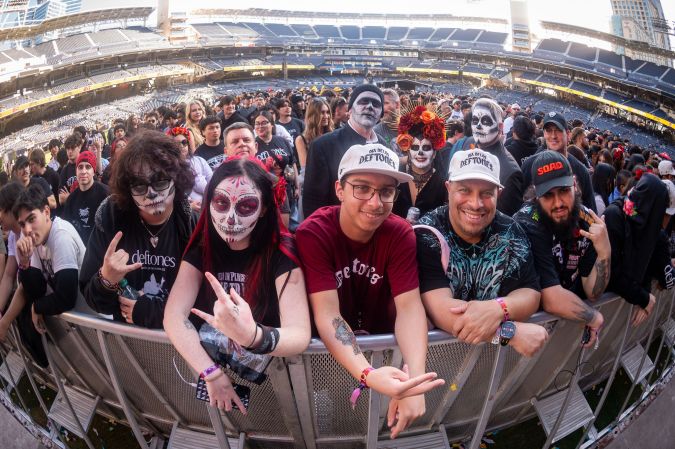
Yet plenty of people did care. Later, three young Latine fans described confronting a woman who joked about working for ICE. These exchanges remind us identity isn’t something we step out of; it follows us even in spaces shaped by our culture. But the night wasn’t without release. During Régulo Caro’s set, he shouted “¡Viva México!” as the stadium erupted, echoed by Clipse’s DJ Yoo Q! It mattered. Black artists uplifting Mexican pride in a scene still confronting anti-Blackness. The cheers said everything. People want to feel seen.
When the world begins to seep into sanctuary, a question lingers: what is our shared responsibility in distinguishing between celebrating culture and contextualizing it? It’s one of 2025’s defining tensions. Identity isn’t just cultural; its sociopolitical terrain. That reckoning is everywhere. Bad Bunny avoided U.S. stops in protest of ICE. Chezile carried a pro-immigrant message on a festival stage. Zack de la Rocha partnered with Born X Raised on anti-ICE merch. These gestures don’t fix everything, but they reflect a climate where silence carries different weight. The issues aren’t new, but the urgency is.
Deftones have never been declarative, and for most of their career, they didn’t need to be. They thrived in fluidity and ambiguity. But as a multicultural band with roots tied to Mexican culture, Día de los Deftones creates a different expectation, one rooted in reciprocity rather than neutrality. Its existence stems from lineage and reverence, not appropriation. Yet the festival—Mexican in name, imagery, tradition, and spirit—becomes a statement simply by existing. And in 2025, that statement lived in a new landscape. Latinidad now functions like an economy where culture carries currency and visibility carries stakes. The line between honoring and marketing feels paper-thin, especially when the community being celebrated is also being targeted.
“Latinidad now functions like an economy where culture carries currency and visibility carries stakes. The line between honoring and marketing feels paper-thin, especially when the community being celebrated is also being targeted.”
None of this asks artists to turn performance into pedagogy. But it does require recognizing the cultural power of art and the influence artists hold when they build worlds people gather inside. Support can’t stay implied. Not because fans demand declarations, but because the world is demanding more from everyone. People turn to artists and the communities they build because that’s where visibility and impact converge. And Deftones awakened a fanbase long erased from heavy music’s center, now one of its most devoted audiences. Choosing not to acknowledge this within the festival’s ecosystem lands differently in a context where hostility shadows the people filling this stadium with cultural pride. A festival rooted in heritage cannot remain separate from the realities shaping it now.
As the world shifts, the meaning of the art shifts with it. The music still holds, but it can’t hold everything. That isn’t a flaw; it’s the growing pain of a legacy moving in real time. And because Deftones built a world where misfits, children of immigrants, and cultural outsiders finally saw themselves reflected in heavy music, this moment hits hard. Ambiguity once felt radical. Today, the world doesn’t offer the same luxury, especially for their Latine and Mexican fanbase navigating a volatile landscape across the U.S. And as 2026 approaches with rising tensions and little sign of relief, these questions stop being momentary reactions and become an ongoing reckoning demanding clearer reflection from all of us.
So if an altar in our honor is going to be built, it takes all of us to tend its flame. And those who light it owe enough intention to make sure no one gets burned in the process.


