
For those of us in the Puerto Rican diaspora, there are moments that feel bigger than celebration. Moments that land somewhere between pride and disbelief when the culture you grew up translating, defending, and code-switching suddenly needs no explanation at all. The past two weekends were that moment. Watching Bad Bunny accept Album of the Year at the 2026 Grammys, then command the Super Bowl halftime stage one week later, didn’t feel like a victory lap. It felt like a reckoning. Puerto Rico didn’t arrive quietly. It arrived intact.
At the Grammys, Benito stood emotional before he spoke long enough for the weight of the moment to settle. When he did, he didn’t shrink it down. “Puerto Rico, créanme cuando les digo que somos mucho más grandes que 100 x 35 y no hay nada que no podamos lograr,” he said. We are bigger than the island’s dimensions. Bigger than how we’re measured. Bigger than how we’re framed. He dedicated the award to those forced to leave their homelands; to those who lost loved ones yet kept going anyway. To the artists who never got to stand on that stage; to Latines everywhere. And when he said “ICE out” before thanking God, it wasn’t as provocation but as clarity. “We’re not savages. We’re not animals. We’re not aliens. We are humans, and we are Americans,” he added. In a room built on approval, he chose truth.
If the Grammys were about recognition, the Super Bowl was about scale.
As the evening sun approached over Levi’s Stadium in Santa Clara, CA, for Super Bowl LX, Bad Bunny emerged not in abstraction, but in specificity: sugar cane fields, jíbaros in pavas, viejitos playing dominos, a piragua stand. Not symbols curated for palatability, but lived references of Puerto Rico as it exists, not as it’s usually packaged. He moved through eras and spaces effortlessly: reggaeton hits flowing into a marquesina party atop the casita from his Puerto Rican residency; Daddy Yankee’s “Gasolina” and other reggaeton classics crashing through the roof as acknowledgment, not nostalgia. A reminder that global success doesn’t erase lineage, but it depends on it.

He introduced himself in Spanish. Performed almost entirely in Spanish. Refused to translate. When Lady Gaga appeared for a real wedding set to “Die with a Smile,” arranged by LoS SOBRiNOS’ Big Jay, flanked by salsa musicians and dressed with a maga (Puerto Rico’s national flower), it wasn’t crossover theater. It was coexistence.
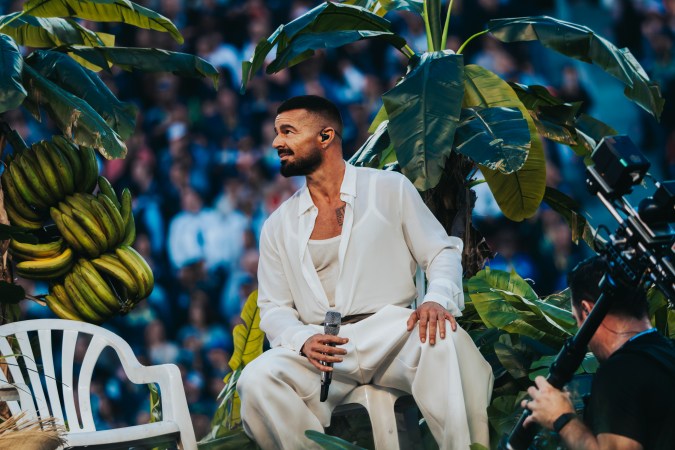
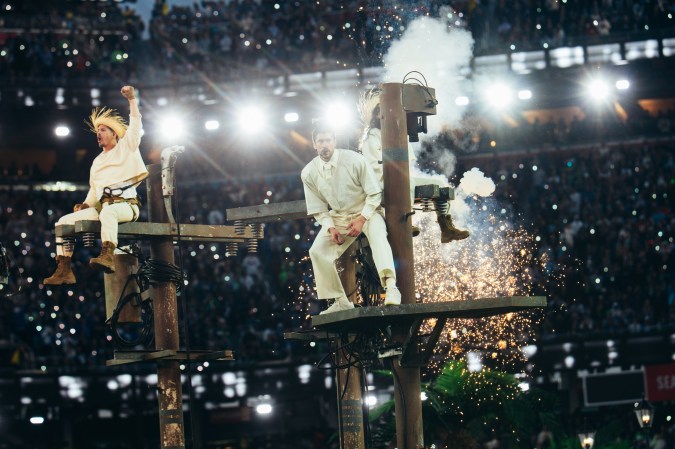
Later, Ricky Martin performed “Lo Que Le Pasó a Hawaii” seated beneath a plantain tree, a visual echo of Debí Tirar Más Fotos. Behind him, jíbaros climbed power poles that exploded, an unmistakable reference to blackouts, Hurricane María, and a power grid that continues to fail the island. That moment bled seamlessly into “El Apagón,” with Bad Bunny holding a Puerto Rican flag in red, white, and baby blue (the colors of the independence movement) on the most-watched stage in U.S. television.
For 13 minutes, Puerto Rico wasn’t a guest. It was the point.

Bad Bunny closed by naming every country in the Americas before landing on the U.S. and Canada, then returning home: “Mi patria, Puerto Rico, seguimos aquí,” he exclaimed. We are still here. Behind him, the screen read: “The only thing more powerful than hate is love.”
For years, Puerto Rican artists were told global success required compromise. Less accent. Less politics. Less locality. These two weekends dismantled that myth in real time. An all-Spanish album won the Grammys’ top prize. A halftime show grounded in plena, bomba, jíbaro imagery, and Caribbean history held the largest audience imaginable.
We’ve spent years watching Puerto Rican culture be trimmed for U.S. consumption, so the emotional response Boricuas experienced yesterday wasn’t just pride, it was relief. The culture didn’t have to bend. The audience did.
Puerto Rico didn’t ask to be accepted. It showed up whole, and the world followed.