

Once a week, a congregation gathers around a single event limited in time and space, a pilgrimage that is a momentary escape, uplifting the spirit from the tedious routines of the week. It is the day to dream and to lift all your prayers to the 11 angels, who will battle their 11 counterparts to defend the illusions and hopes of their believers. The outcome of this encounter will determine whether the coming week will be positive or negative. The winning side will rejoice at the expense of the other, whose prayers seemed to have gone unanswered. These pleas and promises made to god, the Virgin Mary, saints, and all deities: “If we win, I promise to…” Whatever it takes to leave the Sunday pilgrimage with the desired 3 points.
Eduardo Galeano described fútbol as “the only religion without atheists.” A religion that shares a common language with 5 billion followers worldwide, democratic in essence, following a shared ritual devoted to a rounded god in temples that can hold thousands of people at once shoulder to shoulder sharing a wide spectrum of emotions, eyes locked in the same direction, jumping, rattled at the edge of the seat, with something trapped in their chests that can not be put in words, part anxiety, part euphoria, part madness. Triggering temporary altered states of consciousness that can last 90 minutes or more.

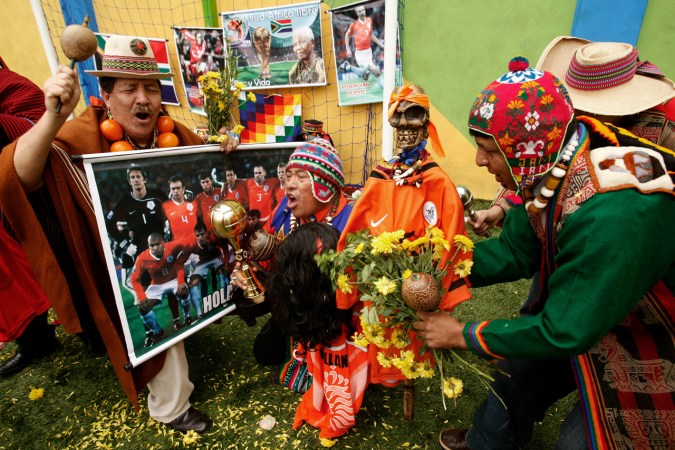
This weekly pilgrimage not only addresses the holy, the good, and the evil, but also delves into superstition, chance, and the occult; losing is not an option, winning is imperative at all costs. The player has their cabalas superstition rituals that will guarantee success. From jumping to the pitch, hopping three times only with your right leg, signaling the cross multiple times when coming on or off, celebrating by pointing to the sky, thanking God, to having family and loved ones as armor in printed shin guards, talismans in religious medals dangling around the neck. There are also several bandages wrapped around wrists, ankles, or legs, providing otherworldly protection. These are not limited to players alone; we, the followers of this pagan religion, the believers, the afflicted, also have our own rituals, celebrated once a week. Like to wear the same jersey every match, one perhaps gifted by their father, sit in the same seat every game, doing a series of prayers, a set of Hail Marys and Our Fathers before the first whistle, carrying religious imagery next to the crest of our team in wallets, cars, and bags.
These pleas and promises made to god, the Virgin Mary, saints, and all deities: “If we win, I promise to…” Whatever it takes to leave the Sunday pilgrimage with the desired 3 points.
These are all performed in hopes of achieving the very desired conquest or to be the balm that soothes the wound, inflicted on the losing side. Las cábalas can be anything that evokes mysticism and the supernatural. In Latin America, these superstitions are rich, syncretic echoes of the region’s ancestral indigenous, African, and Judeo-Christian European backgrounds, shaping our cultural identity.
The stadium is our temple, the concrete vessel where we come to commune, to feel, and to belong. A place of individual release that becomes collective when thousands believe with the same fervor. Here is the only place where their faith turns into affect. My father was one of them, with his love for Independiente Santa Fe, the team all of his (our) family followed in Colombia. Going to the stadium for him meant a safe space where he could show vulnerability. Santa Fe is a team with a philosophy rooted in ardent belief: never giving up, always having hope that, no matter the challenge or adversity, with holy faith (Santa Fe), even the impossible can be overcome. He would embody these sentiments every Sunday. He moved from despair to joy, through pain and comfort. As a man, he never showed emotion as he did every Sunday; there was no mass or ceremony, there was only fútbol. He was a man of no belief other than in his Santa Fe.
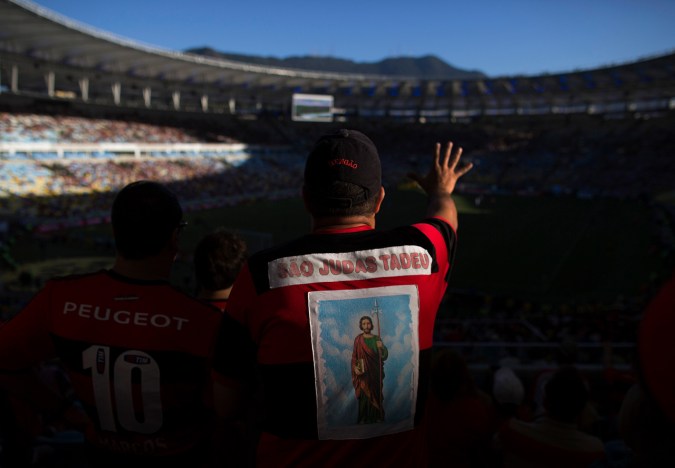
After the ceremony is celebrated, the last whistle blows. The devotee hopes that all the prayers, tears, tricks, and superstitions worked their magic to leave the temple with their heads up, as loud cries and insults slowly give way to silence, the lights extinguish, and nothingness takes over. The angels, demons, the good and bad, are all ready to rest. After so many comings and goings, La Caprichosa heads to a long and well-deserved rest, along with its followers who, after the pilgrimage to the temple, make their way back home already thinking about next weekend’s congregation, with the strong conviction that what they believe in is, was, and will be bigger than themselves.