
Celebrating the FIFA 2026 World Cup comes in different ways. And for these Argentinian artisans, REEFLINE’s Big Goals installation in Miami Beach was the opportunity of a lifetime. A chance to showcase their talent and artistry. But also, a chance to show the world another side of communities that are often ignored and pushed aside.
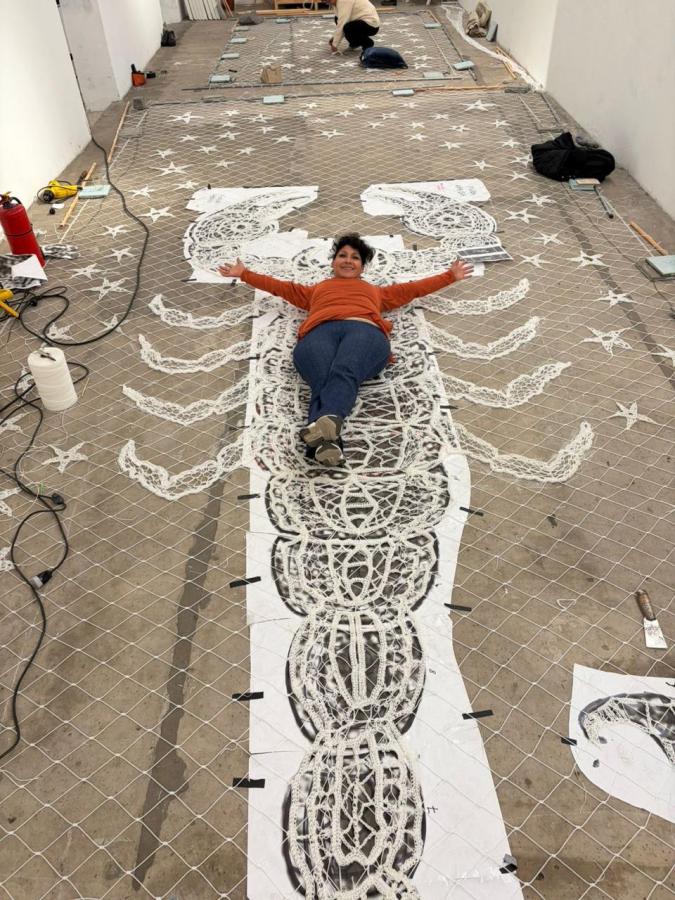
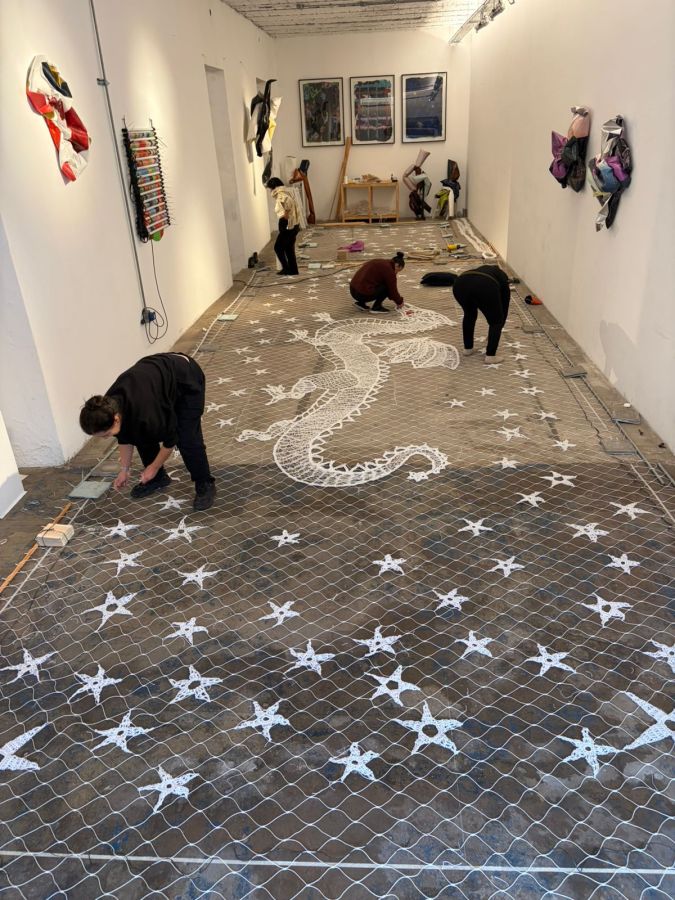
Produced by Argentinian artists Jessica Trosman and Emiliano Miliyo alongside a team of artisans from Argentina and using reclaimed and discarded textile materials, the installation mixes contemporary craft and environmental awareness. It featured two oversized goals whose nets had been hand-crocheted with images of sea dragons, scorpions, starfish, and constellations.
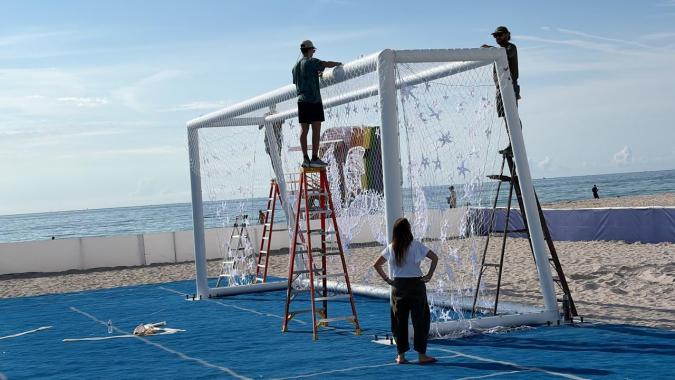
The two nets traced the constellations Scorpius (scorpion) and Draco (dragon), which rest above the skies of the FIFA World Cup players in North America, a metaphor for how the skies connect them to audiences watching from around the world. Crochet was chosen because it’s constructed stitch by stitch, where each stitch depends on the one before it, a metaphor for collective construction that ties well with the idea of teamwork in the World Cup.
How did this come to be? Jessica Trosman, whose background is in textile arts and who has worked for Chanel’s haute couture, shared with us that “when we had the challenge in our hands, we asked ourselves: how do we materialize this? How do we give it a soul?” The answer came in the form of a fútbol net, which Trosman called “one of the most symbolic elements of the game.”

“We wanted to not only take the net as a piece of equipment, but like a sacred place. Because we think all the time, goals. Goals. So the net is very important. I mean, the goals for us are sacred.” Not just because in Argentina, with its rich history, with Messi, goals are a given. But also because of how they bring people together.
And they’re also a metaphor for “human struggle,” one that Trosman and Miliyo were interested in bringing to life. They were also interested in reflecting how futbol brings us all together, especially with this FIFA 2026 World Cup being played across three different countries. “We wanted to highlight that while we might be divided by borders, we are all united.”
It all came together in the form of “the scorpion and the dragon” present in these nets. But the idea needed hands to give it shape.


The real work was done by women from very vulnerable neighborhoods in Argentina, called “villas miseria.” They’re neighborhoods formed on the outskirts of big cities that emerged due to internal migration. These neighborhoods typically don’t have basic infrastructure or much government help.
And these women worked for less than a month, in fact, it was only around 20 days, to crochet by hand the nets we see in the installation. Their names? Natalia Calla, Teresa Inzaurralde, Cecilia Carimullo, Anahi Arriola, Carla Calla, and Perla Ciciliano.
Trosman told us that she’d worked with women from these neighborhoods before, women who on a day to day basis are domestic workers or work numerous jobs to make ends meet, all while trying to sell what they crochet. So for this “there were people gathering day after day, who didn’t do it because they wanted to create fútbol nets, but they were a network of community strength. That’s why we think this is so powerful.”
She added, “that’s why the people who put their time into this, that’s the meaning that we gave it. Bringing it to this world, to the hands of these women. And when you look at these nets, you’re seeing the intersection of the great artists of Los Angeles and the handmade legacy of these incredible women to weave together a network of community and hope.”
And for Trosman, the hands of these women, and the work of producer Clara Zuleta, as well as the vision of Ximena Caminos, Reefline, and Play Lab created something that not only celebrates Miami and Latinidad, but also allows these artisans a chance to shine.
“For so long, we’ve seen women always next to a man, who is the one watching fútbol. There’s a lot of poetry there, a lot of empowerment for these women. There are a lot of things that come out of making this,” Trosman shared. And, she added, “I think what I like the most about all this is that it looks artisanal; it doesn’t look industrial. The idea was that there was the hand, the hand making this. It’s a millenary art; that’s why it has evolved so much.”
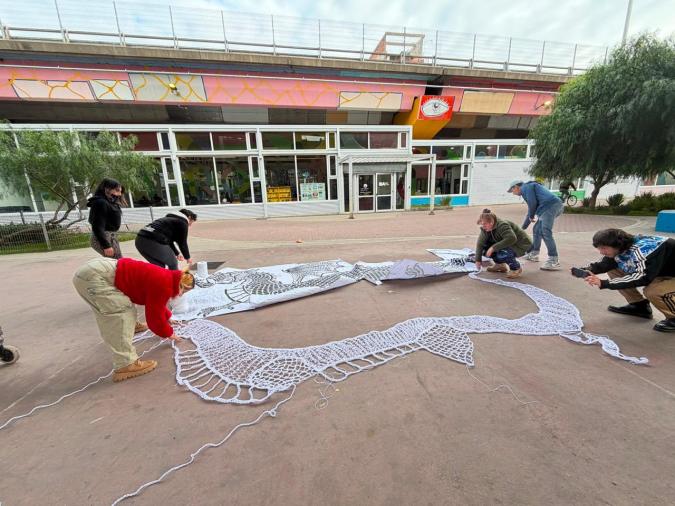
“I think it’s not so much the decoration, the decoration of the net, but about the hands making it. About the effort. The content of these women is tender.” And Trosman’s goal is simple. To make sure people see not just the vision, but what these women can do. Because she would love to “get them more work. They’re always asking me.”